About Catholic Social Ventures
Catholic Social Ventures (CSV) exists to translate the wisdom of Catholic Social Teaching into concrete works that serve people, strengthen communities, and renew culture.
Rooted in the Gospel and guided by the principles of the Church, CSV tries to build and support ventures that take seriously:
The Core Principles
Dignity of the Human Person
The human person is created in the image of God and redeemed in Christ; therefore each person possesses an inherent, inviolable dignity that precedes the State, the market, and every technological system. Human life must be protected and served from conception until natural death, and no person may be treated as an object, a commodity, or a mere instrument of another's ends. Social arrangements are morally measured by whether they recognize the person as the subject, foundation, and goal of social life. (cf. CCC 1700–1706; Gaudium et Spes 25–27; Evangelium Vitae)
The Family: First society, first school of love
The family is the original cell of social life, founded on marriage (an exclusive, lifelong covenant between one man and one woman) ordered to the good of the spouses and the procreation and education of children. As the "domestic Church," the family is the first place where faith, virtue, and solidarity are learned. Public authority serves society well when it safeguards marriage, protects life, supports mothers and fathers, and upholds parents as the primary educators of their children. (cf. CCC 2207–2211; Lumen Gentium 11; Familiaris Consortio)
The Common Good and the Universal Destination of Goods
The common good is the totality of social conditions that enable persons, families, and intermediate communities to attain their fulfillment more fully and more easily, always with justice and peace. Because God created the goods of the earth for the benefit of all, the right to private property is legitimate but not absolute; it is ordered to the universal destination of goods and carries a "social mortgage." Economic and legal structures must therefore promote access to what is necessary for integral human development, especially for those who are poor or excluded. (cf. CCC 1905–1912; CCC 2402–2406; Gaudium et Spes 69)
Solidarity
Solidarity is not a vague feeling but a firm and persevering commitment to the common good, recognizing that we are truly responsible for one another as members of one human family. It demands a preferential love for the poor and vulnerable, and it calls persons, communities, and nations to resist indifference and to build social friendship through truth, justice, and mercy. (cf. Sollicitudo Rei Socialis 38; Fratelli Tutti)
Subsidiarity
Subsidiarity holds that higher levels of authority must not take over functions that can be effectively carried out by persons, families, and local associations; instead, they should support ("subsidium") these lower bodies and coordinate their activity for the common good. This principle protects human freedom and responsibility, strengthens civil society, and restrains both centralized control and the abandonment of the weak. (cf. Quadragesimo Anno 79–80; Compendium of the Social Doctrine of the Church)
Rights and Responsibilities
Authentic human rights flow from the dignity of the person and are grounded in the moral law; they are inseparable from corresponding duties toward God and neighbor. Rights (such as life, religious freedom, the formation of a family, education, work, and association) are not mere claims of will but demands of justice ordered to truth. Responsibility includes the duty to contribute to the common good, to respect legitimate authority, and to practice solidarity, especially where power or privilege can harm the weak. (cf. Pacem in Terris; CCC 2234–2246)
The Dignity of Work and the Rights of Workers
Work is a fundamental dimension of the human vocation: through work the person participates in God's creative and providential care. Because work is "for the person" and not the person "for work," the economy must be ordered so that labor is honored above profit and the worker is never reduced to a tool. Justice requires a just wage sufficient for family life, safe working conditions, reasonable rest, and the right of workers to form associations to defend their interests; it also requires honesty, competence, and faithful service from workers and fair dealing from employers. (cf. Rerum Novarum; Laborem Exercens; CCC 2427–2436)
Participation
Because persons are by nature social, they have both the right and the duty to take part in the economic, political, and cultural life of the community. Participation is a requirement of human dignity and a safeguard of the common good: it resists domination by elites and prevents the exclusion of individuals or groups from meaningful agency. A just society creates real avenues for participation and removes barriers that systematically marginalize the poor, the disabled, migrants, and others at risk. (cf. Gaudium et Spes 75; CCC 1913–1917; Compendium)
Care for Creation
Creation is God's gift entrusted to human stewardship, not a possession to exploit. Respect for the integrity of creation is a moral responsibility: we must use resources prudently, restrain waste, and pursue forms of development that honor both human dignity and the created order. Environmental degradation is also a social sin when its burdens fall first and hardest on the poor; therefore care for our common home belongs to the demands of justice, solidarity, and the common good, within an "integral ecology" that includes the protection of human life and the moral conditions for authentic human flourishing. (cf. Laudato Si'; CCC 2415–2418)
CSV is more than a publisher, incubator, or fund. It is a mission-driven studio: a house where faith and innovation meet. From annotated editions of Catholic classics, to digital ministries like Saint for a Minute and via Sancta, to ventures that bring Gospel values into technology and enterprise, our work seeks to make Catholic Social Teaching tangible in daily life.
Our conviction is simple: holiness is not distant but daily. The Church's social teaching is not abstract theory but a living compass for just enterprise, cultural renewal, and human flourishing. Catholic Social Ventures exists to help founders, creators, and communities build works of mercy in business, media, and beyond.
Catholic Social Ventures. Small works in service of the Church's social teaching.
† J.M.J.A Little About Me
My name is Thomas Ciszek. I am a husband, a father, and above all a Catholic striving to live the call of Christ in the world. My guiding motto is:
Ad plenam felicitatem: cognoscere, amare, laudare, revereri, servire Deo.
Toward perfect happiness: to know, to love, to praise, to revere, to serve God.
I founded Catholic Social Ventures to embody the Church's social teaching in concrete form. It is not for me an idea to admire but a duty to fulfill: to uphold the dignity of every person, to strengthen communities, and to serve the common good with the talents God has entrusted to me.
Providence has led me through many fields: technology, manufacturing, and data. In each I have seen how the work of human hands can serve flourishing when rightly ordered. There I learned discipline, patience, and the weight of responsibility: lessons that now guide me as I seek to build ventures not only for profit, but for justice and mercy.
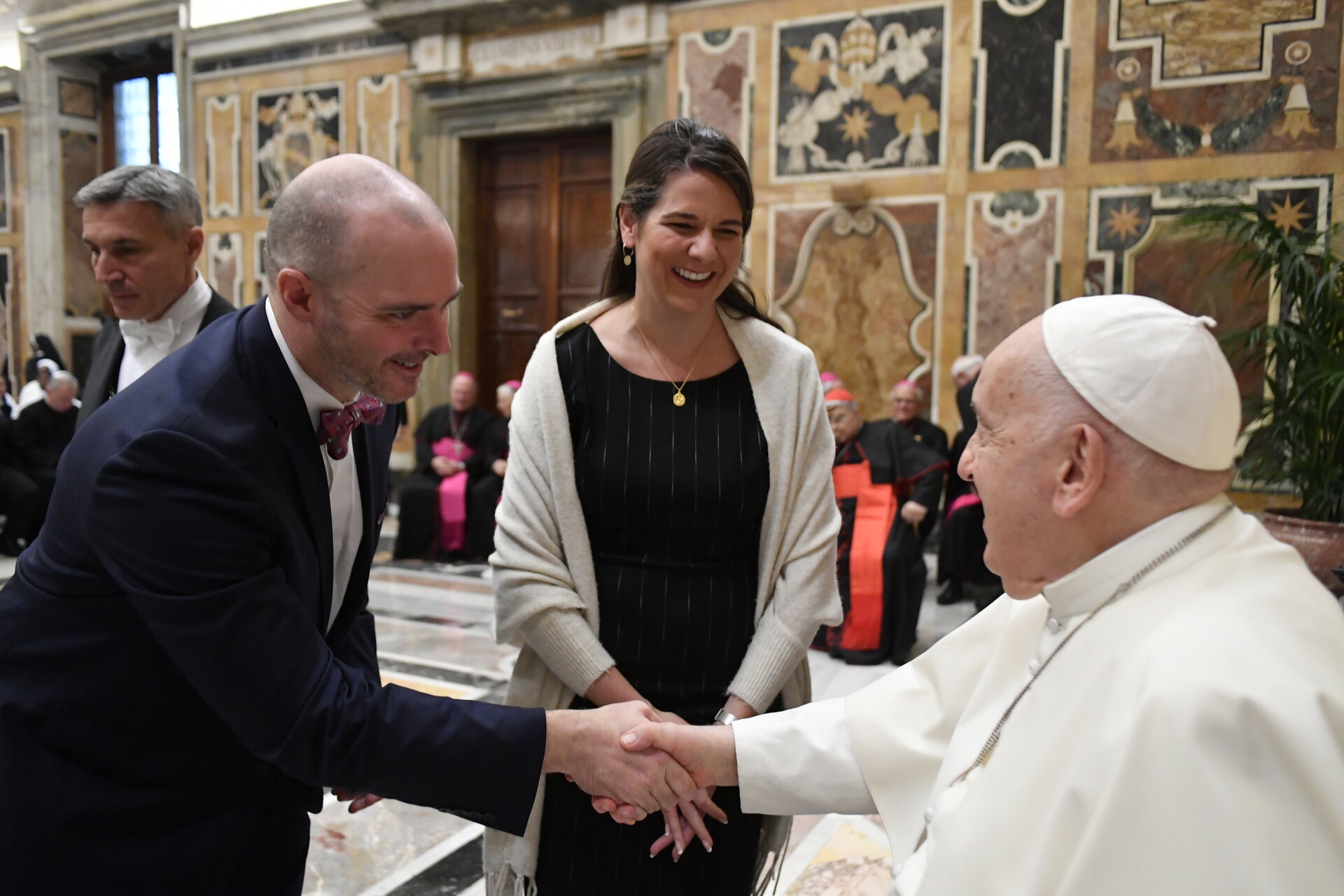
Meeting with Pope Francis at the Vatican
I also labor in the cultural and spiritual fields. I founded Saint for a Minute and via Sancta, ministries to bring the witness of the saints into the digital square. I serve as a Catechist in the Archdiocese of Los Angeles, teaching that holiness is not distant but daily. Along the way, God has granted me unexpected gifts: scholarship, music, even a fleeting moment on screen. These are small signs that every talent, when offered back, can become service.
I live in Santa Monica with my wife Blair and our son Simon. They are my greatest vocation. Faith and family are the root of everything I build and the horizon toward which I walk.